IPHAS: The INT/WFC Photometric Hα Survey of the Northern Galactic Plane
IPHAS is a survey of the Northern Galactic Plane being carried out, in Hα, r and i filters, with the Wide Field Camera (WFC) on the 2.5-metre Isaac Newton Telescope (INT). In the north, IPHAS is being followed by UVEX, a blue-optical INT/WFC survey collecting data in U,g,r and HeI 5876. In the south, a closely-related approved public survey, VPHAS+, will begin data collection on the VLT Survey Telescope (VST) using OmegaCam, once the telescope and instrument has been commissioned (late 2010?). Together, these surveys provide a springboard to a quantitative revolution in our understanding of the extreme phases of stellar evolution. The previous generation of Hα surveys of the Galaxy, conducted over 30 years ago, begin to be incomplete even at mV=12 - the new generation extends this limit down to red magnitudes fainter than 20.
Publications arising from the IPHAS survey are being posted here.
News
Last update: 31/03/2010
IPHAS UNIFORM CALIBRATION Being worked on from late 2009, and may be ready by the end 2010. It is likely that the presently independently-calibrated survey fields accessible via IDR (see also CASU dqc) can be brought on to a common photometric scale, of comparable precision to that of 2MASS and SDSS, at around 0.02-0.03 magnitudes.
IPHAS DATA-TAKING COMING TO AN END By the end of 2008, every survey field had been observed at least once, if not necessarily in good weather. The project is now in a phase of upgrading as many fields to the desired survey standard as weather (and allocation panels) will permit.
IPHAS INITIAL DATA RELEASE The IDR became publicly accessible in December 2007. All data taken up to the beginning of 2006 were uploaded at that time and can be accessed via AstroGrid and via a cone-search tool and image thumbnail server (constructed at IoA Cambridge by Nic Walton and Eduardo Gonzalez-Solares, see Gonzalez-Solares et al 2008). The presently-released data are calibrated at the individual field level - a uniform calibration across the survey area will be in development through 2010. The IDR can be accessed via the Early IPHAS Data page.
CATALOGUE OF EMISSION LINE OBJECTS A preliminary catalogue listing photometry for nearly 5000 objects is available via CDS. Please see Witham et al (2008) for details.
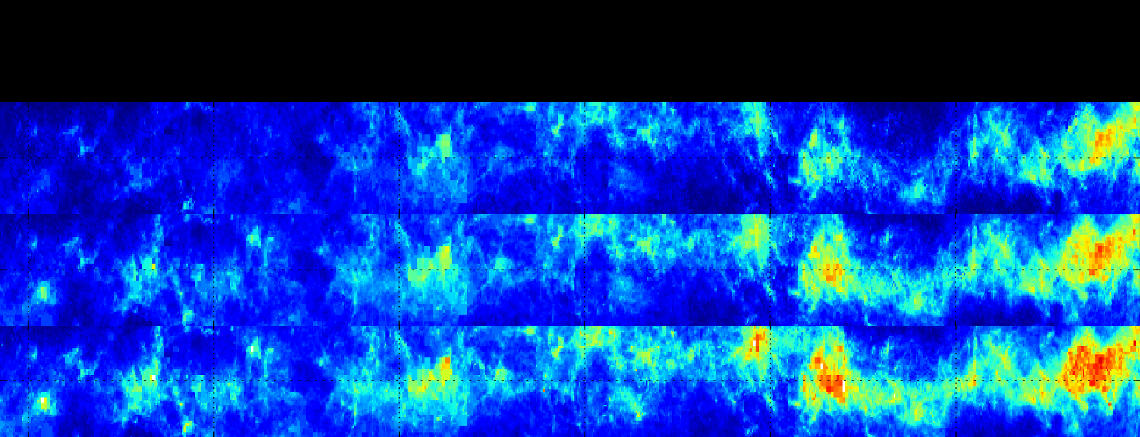
3-D EXTINCTION MAPPING OF THE GALACTIC PLANE THe IPHAS colour-colour plane (see below) can be decoded for intrinsic colour and interstellar extinction for nearly all A-K stars, opening the door to comprehensive high-spatial resolution 3-D extinction mapping of the Galactic Plane. An algorithm to perform this decoding and mapping has been published (Sale et al 2009, MNRAS). A consortium aim is to use this to generate a publicly accessible 3-D map in due course.
NOVA PROGENITORS IPHAS is a valuable resource for identifying nova progenitor objects. The most striking success in this regard has been Nova Vul 2007, or V458 Vul (see Wesson et al 2008). Most unusually, the progenitor object of V458 Vul has an association with what appears to be a planetary nebula. Previously the progenitor object was found for V2362 Cygnus (nova outburst on 2 April 2006, IAUC No. 8697, and see ATEL No. 795. for a report on the progenitor properties). The consortium also identified the progenitor of V2467 Cyg, which went into outburst on 15 March 2007 (see ATEL No. 1031.).
IPHAS imaging
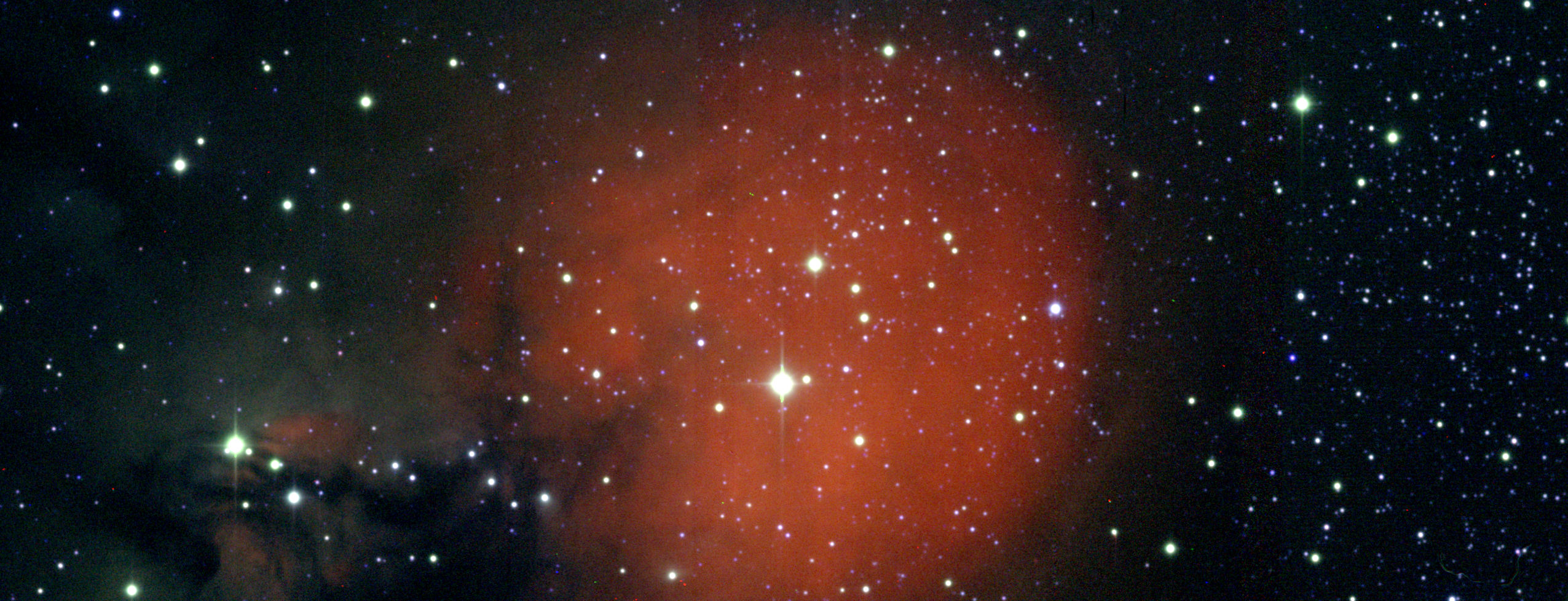
This is a false-colour composite constructed from the IPHAS images of a
pair of overlapping fields in the Cygnus-X region of the northern Galactic
Plane. The colour scheme is red for Hα, blue for the Sloan r band, and
green for Sloan i. As this is a significantly reddened region, as well as
nebulous, there are many stars coming up strongly in the i band -- showing
here as a background of green stars. The data were obtained in October 2003.
N is up and E to the left. (Image prepared by Mike and Jonathan Irwin)
Some fine image mosaics constructed from IPHAS observations are in our image gallery.
IPHAS point sources
The final database is looking set to contain photometry on over 300 million
Galactic Plane objects (cf. SDSS DR5 at ~200 million and the 2MASS point source catalogue, with 490 million).
Among these, the important object classes that IPHAS data pick out:
- compact planetary and symbiotic nebulae; rapidly evolving post-AGB stars
- luminous blue variables (P Cygni and η Car like objects)
- Be stars of all types (including young Herbig stars, and B[e] supergiants)
- dMe stars; clusters of T Tau stars
- a range of interacting binary stars (symbiotics, `supersoft' compact binaries, WD/NS/BH accreting binaries generally)
- H-rich white dwarfs
- large numbers of near main sequence A stars
- M giants
Because of the selection for ionized stars and their nebulae, this survey will increase the stock of known OB associations, and other clusters. As mentioned above, it also provides the basis for an empirical mapping of the distribution of interstellar dust in the Galactic Plane. So, as well as stimulating a better understanding of stellar evolution, this survey has a role to play in the quest to clarify the Galaxy's structure.
This figure is a schematic representation of the (r'-Hα, r'-i') colour-colour plane that IPHAS data define. The points plotted on it are the IPHAS colours of already-known objects falling into the object classes specified in the key. The main stellar locus, occupied by the great majority of normal stars, is located in between the synthetic tracks drawn in black, corresponding to unreddened (left) and reddened (E(B-V) = 4, right) main sequences. For main sequence stars in this region, there is a one-to-one correspondence between (r'-Hα,r'-i') co-ordinates and (intrinsic colour, interstellar reddening): this provides the jump-off point for extinction mapping. The dotted tracks crossing this area are the unreddened and E(B-V)=4 giant-star sequences.
The figure is from Corradi et al 2008. A discussion of the properties of the colour-colour plane, IPHAS survey methodology and sample data, have been presented by Drew et al 2005. (See also the publications page).
|